If you're interested in using any of these photographs or this content in any way, please contact me. Send an e-mail to naturalhistoryphotos(at)gmail.com. Thanks!
Showing posts with label limpet. Show all posts

Friday, August 28, 2026

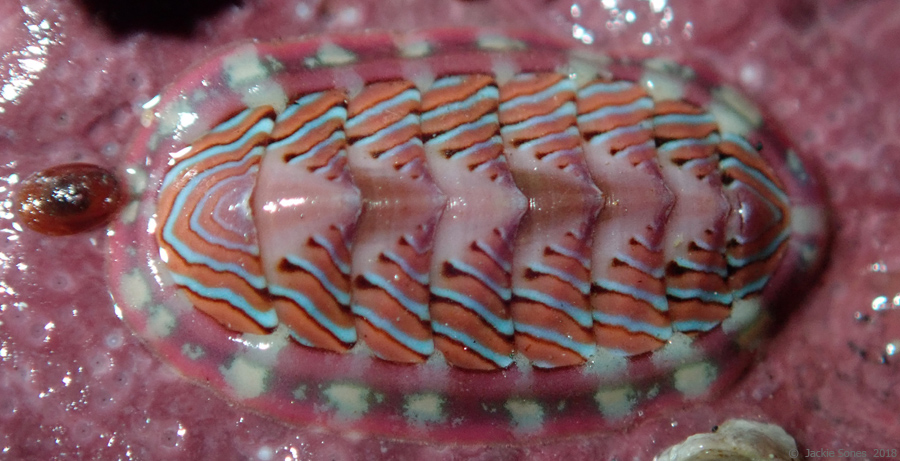
Blue-rayed

A beautiful limpet…from Iceland!  Meet the Blue-rayed Limpet (Patella pellucida).  We’ve done some tidepooling around Reykjavik during the last couple of days and this is a species I hoped to see.  Lots of other amazing marine invertebrates to share, so stay tuned!

Tuesday, June 9, 2026

Reading the shells?


While in Monterey last weekend, we were thinking about southern species that might become more common farther north if a major El Niño event arrives this fall/winter.  For fun, while walking the beach we gathered some shells and ended up with 11 of these species.  We used all of them to spell out El Niño in the photo above.

Three barnacles
: Megabalanus tintinnabulum, Paraconcavus pacificus, Tetraclita rubescens

Six snails
: Acanthinucella punctulata, Californiconus californicus, Hespererato vitellina, Atrimitra (formerly Mitra) idae, Pseudomelatoma torosa, 
Pseudopusula (formerly Trivia) californiana

Two limpets
: Fissurella volcano, Lottia gigantea

You can click on the image above for a larger version, and here's an example with labels, a close-up of the "E":


P.S.  If you're interested, you can follow NOAA's El Niño predictions at this link (updated monthly). 

Thursday, May 9, 2024

Who's the culprit?


This is a scene we came across after finishing field work this morning (9 May 2024).  Some empty-looking whelks (Nucella ostrina) on the sand...and upon closer inspection, their opercula nearby (the operculum is the "trap-door" on the bottom of a snail's foot that seals the opening to its shell when the snail is pulled in).

It looked like the snails had been eaten by a predator, but we couldn't recall seeing this before, so we looked around a little more.

We found even more evidence that something had been eating both whelks and limpets.  Here are a few examples, including snail shells and overturned limpet shells with most of the soft parts missing, but with a thin ring of tissue, evidence that they had been eaten recently:


So...who was responsible for eating these snails and limpets?
 
We weren't sure, but we kept looking, and Eric eventually spotted a clue.  Tracks in the sand around some of the predated shells:
 
 
After thinking through the possibilities, we're guessing these footprints might belong to a rat (!).
 
Rat predation on intertidal invertebrates has been documented previously (Thanks to Sergio!), but we don't recall seeing it locally before.  Maybe because there was a lot of sand at this site it was easier to notice the empty shells and the tracks in the sand.
 
Here's a close-up of one track in case anyone can help us with an identification.  The track was ~1 cm across.
 
 
You learn something new every day!

Thursday, March 7, 2024

A perfect fit


I like the warm colors in this photo, so it seemed like a good opportunity to introduce Lottia instabilis.  

This interesting limpet is stenotopic — meaning that it lives in a narrow range of conditions or a restricted habitat.  Lottia instabilis lives on kelps, especially on the stipes (or stems).  In the Bodega Bay area I've seen it on Walking Kelp (Pterygophora californica).  I don't have a great photo of this species on kelp, but here's one from 2012 so you can visualize where it lives:


One of the unusual things about Lottia instabilis is the shape of the bottom edge of the shell.  To fit tightly against the kelp stipe, which is rounded, the shell is curved upward at both ends:

 
So the shell is "unstable" (or rocks back and forth) if you place it on a flat, horizontal surface (hence the "instabilis" species name).  But if the limpet is on a rounded kelp stipe, it fits perfectly!

Wednesday, January 3, 2024

Four tri's!


Lottia triangularis


Rissa tridactyla


Tritonia festiva


Trifolium macraei
 

Well, I realize it might be hard to see the connection among all of these photos, but I needed something to celebrate NHBH blog post #3,333!  In previous years I noted when I crossed the 1,000 and 2,000 marks, so here's a post to observe crossing 3,000 with four tri's!  Whew!  Thanks for staying with me!

Sunday, December 24, 2023

Home for the holidays


Rough Limpets (Lottia scabra) resting in their home scars.  

Look closely at the three largest limpets and how they fit into the depressions in the rock.  When submerged at high tide, the limpets will crawl around to graze on algae on the rock, but they will return to their individual home scars as the tide falls.  Using a close-fitting home scar might help reduce water loss when the limpets are exposed to air during low tide.

P.S.  I showed another fun example of a limpet home scar back in 2018 — see "Headed home" on 19 May 2018.

Happy Holidays to all!

Sunday, July 10, 2022

Like granite


Fingered Limpets (Lottia digitalis), Eroded Periwinkles (Littorina keenae), and a few acorn barnacles (Chthamalus dalli) on Bodega Head granite, photographed 9 July 2022.

Friday, November 5, 2021

Two volcanoes


We've been working the low tides this week, so I'm running out of time tonight, but here's a quick photo of two Volcano Keyhole Limpets (Fissurella volcano) taken in San Diego.  This is more of a southern species, but we've been keeping our eyes open for them in Bodega Bay.  If you spot one in Sonoma County, I'd love to hear about it!

Tuesday, July 6, 2021

Join the club


When we were in northern Sonoma County a few days ago, Eric called me over to see some high density clusters of limpets.  The limpets were on the vertical sides of some channels.  

The photo above is an overview of the setting, but here's a closer view where you can see 5-6 tight clusters of limpets on the walls: 


And a slightly different perspective:


And here's an even closer view of one cluster (below).  These are Fingered Limpets (Lottia digitalis).  It's a common species in the rocky intertidal zone in this area.  Although this limpet is known to form aggregations, I don't think we've ever seen such striking, numerous and dense clusters.
 
 
So why so many limpets in such dense clusters?  We're not sure, but it could be related to high wave exposure (the limpets might be more vulnerable on the horizontal surfaces), or perhaps predation pressure (again, more vulnerable when horizontal).  Another possibility is that this site has a lot of good food resources, so the limpets are doing exceptionally well, and therefore the clusters have even more limpets than usual.  Perhaps you can think of some other options!

Wednesday, June 16, 2021

Peanut brittle?


Okay, I know I've shown a few peanut worms recently, but this was a nice view of several different peanut worms (Phascolosoma agassizii) extending their introverts from a crevice and using the short ring of tentacles at the end to feed.  You can also see several arms of a brittle star extending out of the crevice and even lying across one of the peanut worms.

P.S.  If you want to play the "phyla game" again, look around to see what you can find.  Below I'll list the phyla in this image.

1. Peanut worm (Phascolosoma agassizii), Phylum Sipuncula
2. Brittle star, Phylum Echinodermata
3. Barnacle, Phylum Arthropoda
4. Limpet (checkered, in lower left corner), Phylum Mollusca
5. Tube worm (
orange tentacles, upper right corner), Phylum Annelida
6. Flatworm (gray/white, same species as last night), Phylum Platyhelminthes

Sunday, February 7, 2021

This way and that way -- Part 2

Last night I posted a mystery photo that looked something like this:

 
This is probably a hard one to identify unless you've spent some time around marine invertebrates.  Doesn't it look like a petroglyph?  Here's another view:


These are the grazing marks of a limpet on an intertidal rock surface.  A limpet scrapes microscopic algae off rocks with its radula — a long membranous ribbon (it looks somewhat like a tongue) that's armed with many rows of tiny teeth.  Most of the time you don't get to see the results of their feeding bouts, but occasionally the conditions are just right and the route that the limpet took while grazing is revealed:

 
This patch of grazing marks was extensive!  It was fun to look around to see the various paths that the limpet followed.  (You can click on the images for larger versions.)
 
 
Munch, munch, munch!

Tuesday, February 18, 2020

Hold on to that shell


I've been doing some photo organization, so here's one of the last images I sorted tonight — Lottia asmi, a small dark limpet that often lives on Black Turban Snails, photographed on 24 February 2018.
 

Thursday, July 26, 2018

What did the limpet say to the chiton?


"Wow, I didn't know Big Foot was so pink!"


Okay, I'll admit this is a stretch (and that I might be overtired).  I was playing the "caption game" with this photo, trying to come up with an interesting caption describing what was going on in the picture.  What would the little brown limpet on the left say when it encountered the larger pink chiton?  [Remember that a chiton has a large foot to hold on to the rock.]

When I thought of the caption above, I couldn't stop laughing.  (Seriously!)  I'm not sure why...maybe because it's funny to imagine the real Big Foot (the woodland creature that most people think of) as being bright pink instead of brown?

Do you want to play the caption game?  Can you think of a fun caption for the photo above?  Let me know!

P.S.  Here's another one — "Hey, dude — nice striped pajamas!" 

Tuesday, June 5, 2018

Hanging in the balance?

Last week, after finishing field work in the rocky intertidal zone, Eric looked up to see something odd.  There was something hanging vertically from the corner of a boulder:


Huh.  We both wondered what it was, so we moved closer for a better view:


Weird!  Now we could see that it was a stack of small limpets hanging down below the rock.  Neither of us could recall seeing something like that before. 

So I had lots of questions.  How did they end up in that position?  Did they just start "stacking down," with one limpet moving down and then another one moving down a little lower and so on?  Why would they do that (i.e., leave the solid rock and move into what seems like a tenuous position)?  When there is high density of limpets, and it's hot, do the limpets crowd into the shaded overhang, where some limpets are forced to crawl onto each other (below the tip of the rock)?

Is there only one limpet holding on at the top?  Can they crawl back up to the rock?  (Or is there a risk of upsetting the balance and dislodging the entire stack?)  When the incoming tide/waves splash the hanging limpets, how will they respond?

We'll never know the answers, but it was an intriguing way to end the morning.

Have you ever seen a limpet stack like this?

P.S.  We didn't have much time, so I'm not sure of the limpet species, but it appears to be Lottia digitalis or Lottia paradigitalis, or a combination of the two.

Saturday, May 19, 2018

Headed home


Rough Limpets (Lottia scabra) are known for having home scars — a site that the limpet returns to consistently when not foraging.

Home scars can be multi-dimensional, with the upper level of the home scar fitting the shell margin, and the lower level fitting the shape of the foot.  The scars are often eroded into rock, although in the case shown above, the form-fitting scar is worn into a layer of pink crustose coralline algae.

Can you see how this intertidal limpet fits into the scar (at the left) by matching the shape of the shell to the outline of the home scar?

Scientists studying the benefits of home scars have shown that the scars can prevent desiccation, reduce predation (with many predators, but not all), and increase survival after burial by sand.

P.S.  If you're curious about orientation, the head of the limpet is at the narrow end of the shell.

Sunday, January 28, 2018

Field of bubbles

This afternoon I was looking into a tidepool and was intrigued by all of the bubbles attached to the surfgrass (Phyllospadix sp.).  I decided to try to get a picture from an underwater perspective.  Here's the first shot:


That was pretty fun, so I decided to try another from a little further away to show the extent of this "field of bubbles."  [I was kneeling next to the tidepool, holding an underwater camera below the surface, so I couldn't quite see what was in the frame.]


Wow!  It worked pretty well...and there was a bonus!  A nice Surfgrass Limpet (Lottia paleacea) was in the center of the photo near the top.  This limpet is remarkably well adapted for life on a surfgrass blade.  [For an introduction to the limpet, see the post from 7 June 2012.]

I kept taking pictures from different positions, and I ended up with one more image of the surfgrass blades, the bubbles, and the limpet:


I'll definitely keep trying to capture this beautiful underwater scene in other surfgrass meadows!

Friday, December 1, 2017

Blade runner

I first wrote about Surfgrass Limpets (Lottia paleacea) several years ago (yikes, almost 5½ years ago now!) — see the post called "Chemical camouflage" on 7 June 2012.

Tonight I took a couple of pictures of this limpet that made me curious:


Remember that Surfgrass Limpets only live on surfgrass (Phyllospadix spp.) blades, which are very narrow (depending on the species of surfgrass, only ~0.5-4 mm across).

Generally when I see a Surfgrass Limpet, it's a single individual on a blade.  This is the first time I recall finding two limpets next to each other.  So then I wondered — can Surfgrass Limpets turn around on the blade?  Or, do they only move back and forth?  If there are two limpets on one blade, do they compete for food?

Here's the next photo:


I noticed at least one individual that looked different from the others — it was smaller and much paler, appearing pale green, at least when looking down on a cluster of surfgrass blades.

Many of the Surfgrass Limpets we see are brown, and they're often ~10 mm long.  This individual was only ~4 mm long (note millimeter marks on the ruler above).  Is this a juvenile Surfgrass Limpet?  If so, how old is it?  What time of year do the adults spawn?  When do the larvae settle out of the plankton?  Is the pale coloration a variation, or is it more typical of juveniles, or is it a signal of new shell growth?

Lots of questions for which I don't have answers, but it's always fun to wonder, especially when you look at a familiar species from a different perspective!

Monday, April 17, 2017

Spot-on

I was sorting through some pictures from last spring when I encountered this one:


I said to myself, "Huh...do Two-spotted Keyhole Limpets (Fissurellidea bimaculata, formerly Megatebennus bimaculatus) eat sponges?"  It certainly looks like the limpet (relatively small, dark brown shell surrounded by a bright yellow mantle) had been eating the green sponge (Halichondria sp.).  

So I read the species account in Intertidal Invertebrates of California which said this:

"This species often occurs on compound ascidians where the color pattern provides good camouflage.  In the laboratory, Megatebennus has been observed feeding on compound ascidians, and sponge spicules have been found in the gut of specimens collected in the field."


And then I laughed, because the next photo I found was this one:


The Two-spotted Keyhole Limpet above is in the center — with a dark brownish shell (barely visible) surrounded by a pale yellow mantle.  It's flanked by several compound ascidians, and you can see how well camouflaged it is.

The description in the species account by Don Abbott and Gene Haderlie was spot-on!

Saturday, March 19, 2016

Key features


Hooded Keyhole Limpet (Cranopsis cucullata, formerly Puncturella cucullata)

Photographed on 12 March 2016.  This species is more common subtidally — I've only seen a handful washed up on the beach in this area.

The "keyhole" is a normal feature, i.e., this is *not* a broken shell.  The hole, or slit, is located just in front of the apex (peak) of the shell.  The position and shape of the keyhole, along with the strong ribs and the dentate margin, are useful identification features.

P.S.  The species name, "cucullata," means "hooded" — sometimes the apex of the shell leans backward (like a hood).  [I should have taken a picture from the side; I'll try to add one.]  This expands the list of "hooded species" with cucullata in their scientific name — see the post from 18 June 2015.

Monday, October 28, 2013

All aboard!

A couple of days ago, on 26 October 2013, an unusual object on the beach caught my eye:


This is what it looked like when I flipped it over (next image).  It was ~11 inches long.


It was a little wooden boat!


It was puzzling to wonder where it had come from.  All of the parts were wooden except for four metal hooks on the upper deck (one was missing) and a few small metal nails or tacks along the keel.  It looked like there used to be a mast in the center.  The boat had been painted, and at some point it had been burned (see charred markings).

I was also very curious about the animals that were aboard.  They were small, but if you looked closely you could see quite a few animals living in the grooves of the boat:


Because of their size, I decided to look at the animals under a microscope.  It was a whole different world, and after doing a mini-survey, this is what I found:


Two species of acorn barnacles (larger one on the left with orange on the inside of the opercular plates, and smaller ones on the right).


One species of gooseneck barnacle (possibly Pollicipes sp.?) — it's the small stalked barnacle at the upper edge of the photo.


A spirorbid tube worm (white tube between the barnacles).


A teeny-tiny brown limpet (very magnified in the image above).


Long byssal threads that indicate mussels used to live on the boat, too.


And finally, a mystery critter!  My first thought was bryozoan, but then I questioned that and wondered about tunicate (or sea squirt).  I haven't seen many of them this small.  If you're more familiar with them at this size, perhaps you can help with an identification?  Below is another view, showing that this animal is stalked and branched.


It was an intriguing assortment of life aboard a little wooden boat!