One of the things I enjoyed most about Iceland is how close you feel to the basic elements of the earth.
Here are some photos that represent different forms of earth, water, and air. As always, you can click on the images for larger versions.
One of the things I enjoyed most about Iceland is how close you feel to the basic elements of the earth.
Here are some photos that represent different forms of earth, water, and air. As always, you can click on the images for larger versions.
We've been busy with field surveys recently, but I wanted to share one photo illustrating the impacts of the intense storms in January this year. We're currently visiting sites that we survey once per year, so we're just now gaining additional insight into the impacts from the winter storms.
This is one example of wave impacts to a rock wall causing it to fracture resulting in giant sharp-edged rocks filling a surge channel. The clean gray angular rocks towards the middle of the photo are newly fallen off the wall to the left side of the channel. (We estimate those rocks are ~5 feet tall.)
Another reminder to be careful near bluff edges and coastal outcrops!
Fingered Limpets (Lottia digitalis), Eroded Periwinkles (Littorina keenae), and a few acorn barnacles (Chthamalus dalli) on Bodega Head granite, photographed 9 July 2022.
On our way out to a field site recently we came across a Black Oystercatcher (Haematopus bachmani) nest. We moved on so as not to disturb the birds, but I took a quick photo with my telephoto lens. It is such a beautifully constructed nest! Hundreds of rock chips gathered to produce a shallow bowl.
Later I was reading a short story by A.S. Byatt and was struck by the phrase "in a wilderness of stones." She was writing about "moor birds" (perhaps grouse in Great Britain?), but my mind went immediately to this oystercatcher nest. Looking at the photo we were struck by the number of stones used to make this nest, and the phrasing seemed just right, describing both the eggs surrounded by stones as well as the world of Black Oystercatchers.
With thanks to A.S. Byatt, the oystercatchers, and the stones, and the elements that shape them.
After field work this morning, I was hearing some Cliff Swallows (Petrochelidon pyrrhonota) calling and was wondering where the swallows were. In trying to locate the birds, I was puzzled at first the my ears were leading me to an offshore sea stack. But then a few birds appeared and swooped up into a groove in the rock! I'm probably not in the right places often enough to see this, but I couldn't recall observing them nesting on a sea stack before. Looking more closely, I eventually found a few nests.
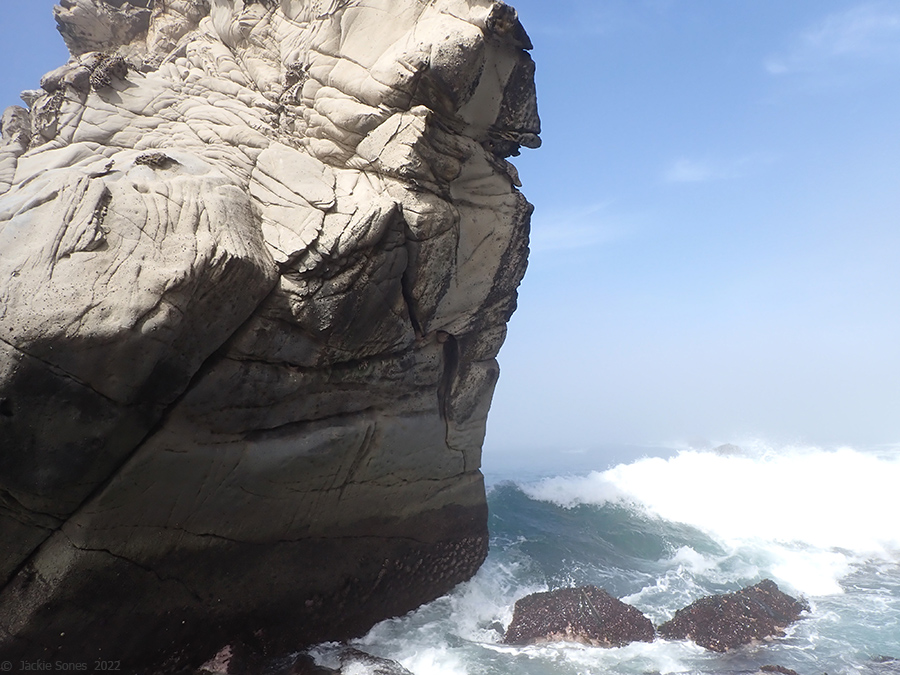
Above is a view of the sea stack. The nests are in two locations — next to the jagged notch (cut-out) at the upper right corner of the rock, and along the dark groove that curves down vertically at the lower right corner of the rock. Below is a closer view where you can look for the rounded mud nests attached to the rock:
A few photos of rocks from along the northern Sonoma coast this past weekend. Thanks to Eric for his excellent eye and framing some beautiful patterns!
Barnacles following the grooves in the rock. They like to live along edges!
P.S. If you're wondering, the barnacles pictured are primarily Chthamalus dalli.
Rocks, lichens, mosses...and an owl! Can you spot it?